Home › Services › Wood Siding Replacement
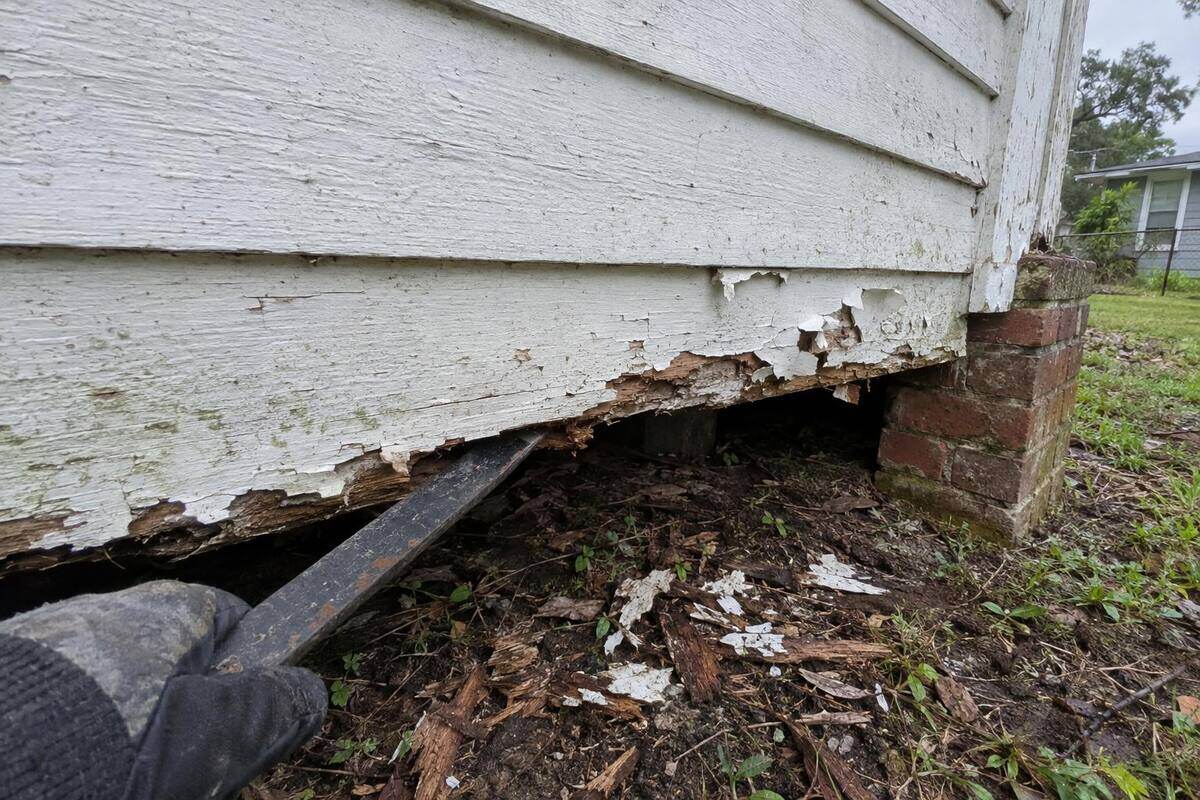
A large share of the houses built in Beaumont, Port Arthur and the Mid-County towns before 1970 still wear the wood lap siding they were built with. Some of it has been painted a dozen times and is fine. A lot of it has reached the point where the bottom courses are soft, the butt joints have opened, and the next paint job would be money spent on rot. This page is about that house.
From the bottom up. The lowest courses sit closest to splash-back from the roof runoff and to the damp air of the crawl space, and on a house with no gutters they have been wet on both faces for decades. Then at the joints: butt ends that were never primed wick water, swell, and open. Then at the corners and around windows where the trim was face-nailed and the caulk has long gone. Wind-driven rain in a storm finds every one of those and puts water into the wall. That is the wall Laura's wind found across Jefferson and Orange counties in 2020.
A contractor's first visit is a screwdriver test along the bottom two courses and every joint at eye level. If it goes in, that course is done; if it goes in on every wall, the house is a re-side, not a repair. The repair page is for the other outcome.
The least expensive whole-house option and the most common one in this county for that reason. Handles moisture well; has a wind-pressure rating that has to suit the site and can distort in reflected heat. Both limits are stated on its page.
Heavier, costlier, painted, and closest in look to the original lap. Handles humidity and wind-driven rain without vinyl's limits. Roughly half again to twice the installed price of vinyl on the same house, as a range.
Rarely chosen here for a whole house: it costs more than fiber-cement once primed and painted, and it starts the same seventy-year clock again in the same climate. Sometimes right for a street-facing wall on an Old Town house where the look matters.
A household at Beaumont's median income is usually choosing between the first two, and the honest advice is that either is a sound choice when installed properly over a sound, flashed, house-wrapped wall. The wall preparation is where cheap jobs go wrong, not the material.
TWIA's windstorm-certification page lists “re-siding a significant portion of an exterior wall” among the improvements that require a Certificate of Compliance, in the same list as replacing a roof. In Jefferson County that means a whole-house re-side is built to TDI's adopted specifications for wall cladding attachment and inspected by a TDI-appointed inspector or a Texas-licensed engineer before TDI issues the certificate. The contractor builds to the specification; the contractor does not issue anything. Details on the certificate page.
Applies in Beaumont, Port Arthur, Nederland, Port Neches and Groves. In Vidor, Orange, Bridge City and Lumberton there is no windstorm inspection requirement; see those city pages.
If the screwdriver test passes and the joints are tight, yes, and a contractor should say so rather than sell a re-side. If the bottom courses are soft, paint is a coating on rot.
A whole-house or significant re-side in Jefferson County does, by TWIA's list. A repair of a few boards does not. In Vidor, Orange, Bridge City and Lumberton the requirement does not exist.
Often board sheathing, sometimes nothing but the studs and a layer of felt or paper. What is found decides the wall preparation and part of the price; ask for it as a separate line.
Say which city and how much of the house it is. A contractor who re-sides older Jefferson County houses calls back.
Call (409) 248-2181 Request a Free Estimate Beaumont Roofing