Home › Services › Roof Replacement to Windstorm Specs
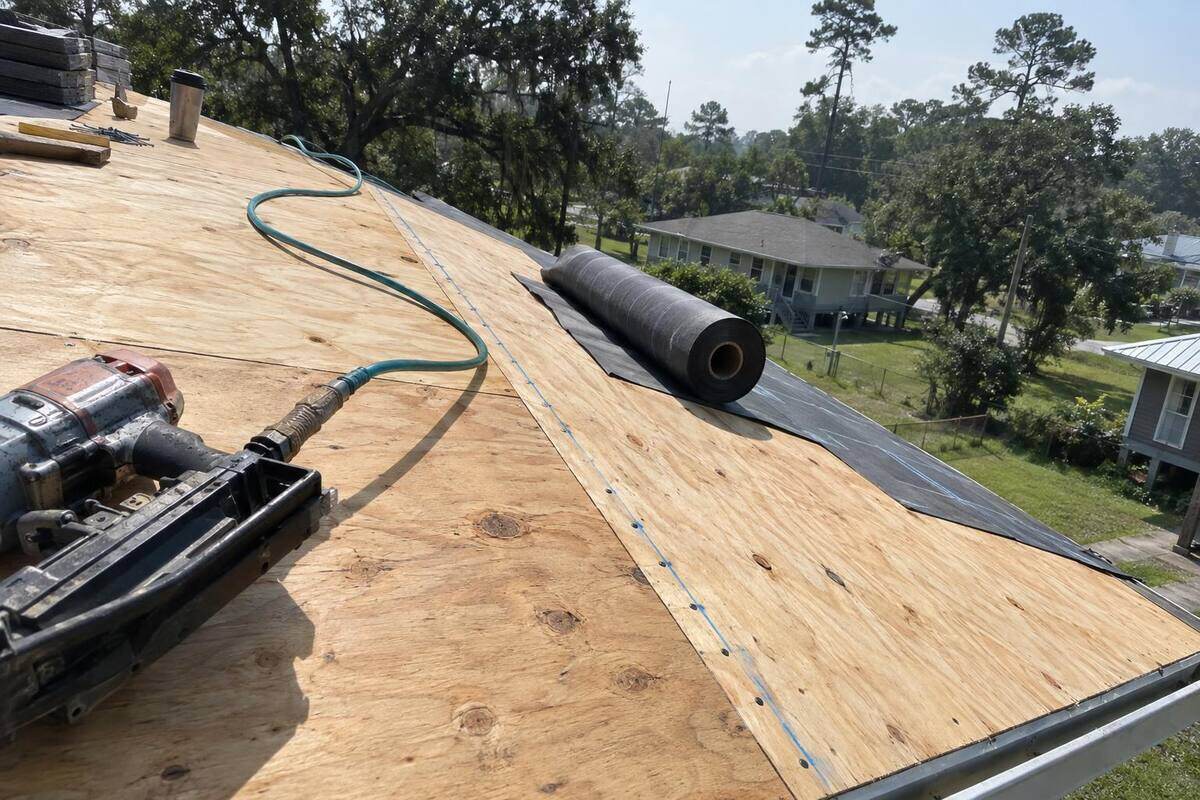
A roof replacement in Jefferson County has an extra party to it. The homeowner, the contractor, and a TDI-appointed inspector or licensed engineer who looks at the decking, the nailing and the edges before the certificate can be issued. This page is about what that means on the roof, in the order the work happens.
A one-line quote with a total is not a scope. In Beaumont the document worth asking for names the shingle line and its wind rating, whether the old roof comes off or is covered over (in the catastrophe area, expect tear-off), how the decking will be attached and what happens if plank decking has to be replaced with sheathing, the underlayment, the drip edge and how it is fastened, every flashing detail, ventilation, and the workmanship term separate from the manufacturer's warranty.
The inspector reads the same lines. TDI's adopted specifications for the designated catastrophe area cover decking attachment, fastener type and spacing, underlayment and edge metal in a way a Houston roof never has to meet, and the contractor's job is to build so that every one of them is visible and correct when the inspector arrives. The certificate page has who does what.
Much of the pre-1970 pier-and-beam stock in Old Town, the North End and Port Arthur was decked with one-by boards, sometimes with gaps. The specification's attachment rules are written for sheathing; the contractor prices what happens if planks come off.
Low-slope additions from the 1960s and 1970s meet the main roof at a wall or a step. Those transitions are where Imelda's rain got in for three days. Flashing there is scoped separately.
Attics over 120°F for five months cook a roof from below. Intake and exhaust ventilation is part of the scope, not an upsell, and it is easier to add during a tear-off than ever again.
Applies in Beaumont, Port Arthur, Nederland, Port Neches and Groves. In Vidor, Orange, Bridge City and Lumberton there is no windstorm inspection requirement; see those city pages.
Median household income here is $56,997 and the median home is worth about $166,400, by DataUSA's 2024 profile. A roof is a large share of that house's value, and the contractors this site works with quote accordingly: architectural shingle built to the specification as the default, metal as an option with its price stated, and no scope padded with products the inspection does not require. If a quote arrives with three tiers and a “premium” underlayment nobody asked for, ask what the specification actually requires.
Two honest notes. A roof that passed inspection in 2009 was built to the specification of 2009, and the one that replaces it will be built to today's; expect some detail to be different, and expect it to cost a little more than the last one did. And on a house with plank decking, the sheathing line item is the one that moves the total, so ask for it as a separate price before the tear-off, not after.
One to three days on the roof for a typical single-story house once material is on site, then the inspection, which is scheduled separately. Gulf Coast rain is the usual delay.
The homeowner does, by TDI's fact sheet: either a TDI inspector, described there as complimentary, or a Texas-licensed engineer or TDI-appointed qualified inspector. The contractor will tell you who is active locally and when the roof is ready to be looked at.
In the catastrophe area, expect it to. The inspector needs to see the decking attachment and the fastening, and neither is visible through an old layer. Ask the contractor to say in the scope whether it is a tear-off.
Tell us which city, roughly when the house was built and whether it sits on piers. A contractor who builds to the specification calls back.
Call (409) 248-2181 Request a Free Estimate Beaumont Roofing