Home › Services › Roof Repair and Leak Repair
Not every roof job in Jefferson County is a hurricane story. Most weeks it is a stain on a ceiling in the West End, a drip in a Nederland utility room, or a soft spot on a porch roof in Groves that has been slowly getting worse since Imelda. This page is about the repair that is honestly a repair.
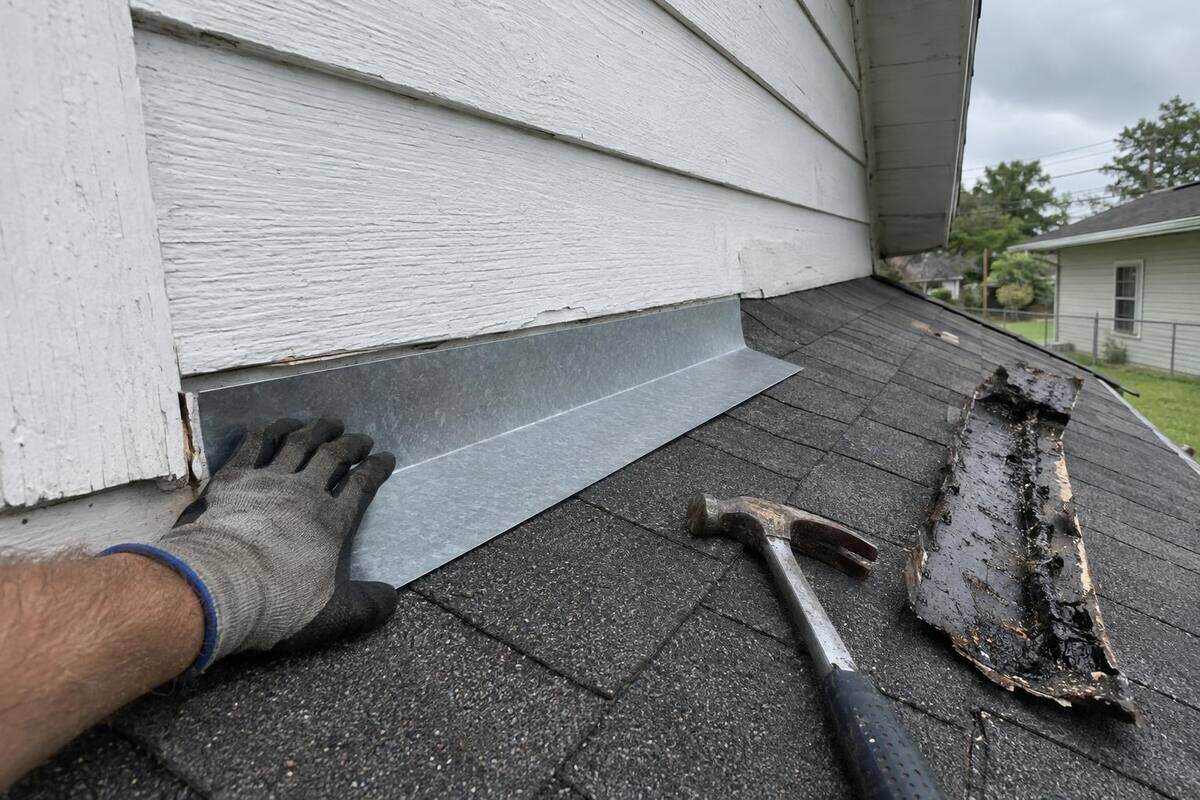
A low-slope porch or carport roof added to a wood-sided house meets the wall at a step or a kick-out. The flashing there was often never done, or was done in tar that dried out two decades ago.
The rubber collar around a plumbing vent cracks in a Beaumont summer within ten years. The leak shows up on a ceiling several feet downhill of the pipe.
Where a gable addition meets the original roof, needles and leaves from the live oaks collect and hold water against the shingle. Metal valleys corrode from underneath.
On pre-1970 houses the decking is boards, not sheathing. A nail through a knot or a gap holds nothing, and a shingle on it lifts in ordinary wind, not just a named storm.
Small repairs are small. Replacing a vent boot, refitting flashing at a porch, closing a valley, patching a few square feet of decking: none of that is on TWIA's list of work that needs a Certificate of Compliance, and none of it should be sold as if it were a re-roof. A contractor who turns a cracked boot into a replacement quote on the first visit has not earned the second one.
The line is “repairing a significant portion of a roof,” TWIA's phrase, at which point the repair is built to TDI's windstorm specification and inspected like a replacement. A repair that keeps growing on site, from one slope to two to the ridge, can cross it. Ask the contractor to say which side the job is on before it starts, and if it crosses, to stop and say so.
Applies in Beaumont, Port Arthur, Nederland, Port Neches and Groves. In Vidor, Orange, Bridge City and Lumberton there is no windstorm inspection requirement; see those city pages.
Two Beaumont-specific false alarms. After Harvey and Imelda, ceilings stained from water that never came through the roof: attics stayed saturated for days in ninety percent humidity, condensation dripped from ductwork and from the underside of the decking, and the stain appeared weeks later. And on a pier-and-beam house, a wall stain can be wind-driven rain coming in through failed siding or trim rather than through the roof. The contractor traces the water up before pricing anything.
Often, once the source is found. Finding it is the work; a vent boot or a flashing kick-out is an hour's fix after that. Decking replacement takes longer and is priced by the square foot.
Not for a small one. TWIA's list of work that does not require a certificate includes temporary storm repairs and gutter work, and small maintenance repairs are of that kind. A large repair is another matter; see the page above.
A roof from 2006 is nearly twenty years old, which is the end of a composition roof's life in this climate. A repair buys time; how much depends on the rest of the roof. Ask for an honest read of the whole roof along with the repair price.
Describe where it shows and when it started. A contractor who traces leaks on older Jefferson County houses calls back.
Call (409) 248-2181 Request a Free Estimate Beaumont Roofing